

Stop chasing partner activation information.

Every partner’s activation details come in complete, by the deadline. You see who still owes what, and only approved information reaches your game day memo.

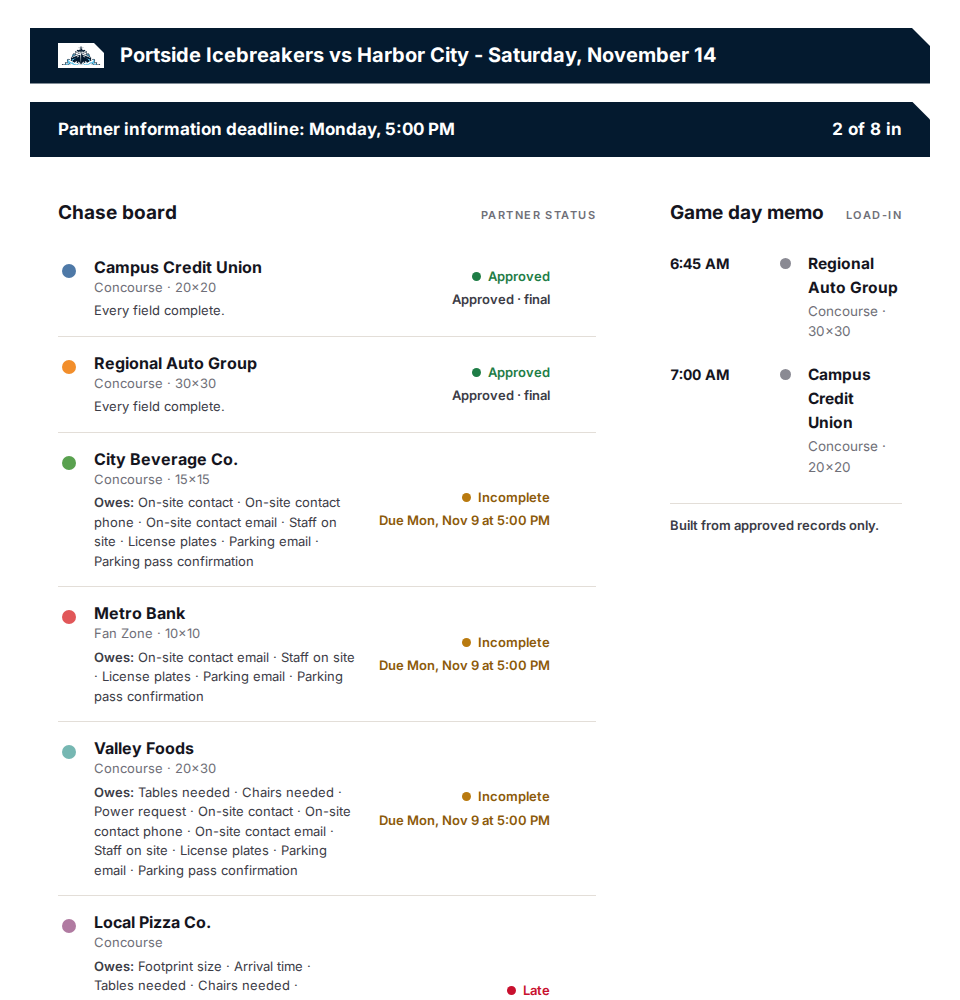
The By Face Off chase board as the partnerships rep sees it, for the sample game, Portside Icebreakers vs Harbor City: three partners still owe information against the Monday 5 PM deadline, each one's missing items named.
Every partner’s status, and who still owes what, in one place.

Game day still runs on a spreadsheet and an inbox.

The sample game workbook on its Control tab: a hand count of 24 tables and 74 chairs, against 21 tables and 61 chairs pulled from the Totals tab.
The sample game’s workbook. The hand count says 24 tables and 74 chairs. The totals say 21 and 61.
  • A partner arrives at the wrong place, at the wrong time.
  • A partner inside the arena doesn’t know where to set up on the concourse.
  • A shipment reaches the arena and the operations team never hears about it.
  • A change lands two days before the game and gets buried in email.

Your team finds out in front of the partner, the arena staff, or the fans.

After three home games

When everything is in early, game day at the rink is quiet.

  1. Events & Game Operations is no longer routinely chasing partners.
  2. Partner information flows into appropriate operational fields.
  3. Late changes decrease.
  4. Arena asset requests are easier.
  5. Fewer details are missed.
  6. Departmental accountability is clearer.
  7. Arena communication improves.
  8. Staff spends less time on manual coordination.
  9. Fewer game-day problems are caused by information that should have been known earlier.

We know how game day goes.

Information comes in incomplete. Someone has to chase it. The handoff to Events runs late. Puck drop turns into a scramble, and your team ends up fixing it on the concourse, in front of everyone.

We cover everything before the show. Nothing about the show itself.

Your rundown stays where it is. We do not replace your show-calling software. Show timing is yours.

Credentials stay where they are. We do not touch them.

Nothing gets typed twice. We do not create another place to enter the same information.

Send us your rundown export (CSV or spreadsheet) at the checkpoints you choose. You get back three things: an import-ready load-in schedule, the game day memo, and the asset totals, each as a document.

Three steps to a complete memo

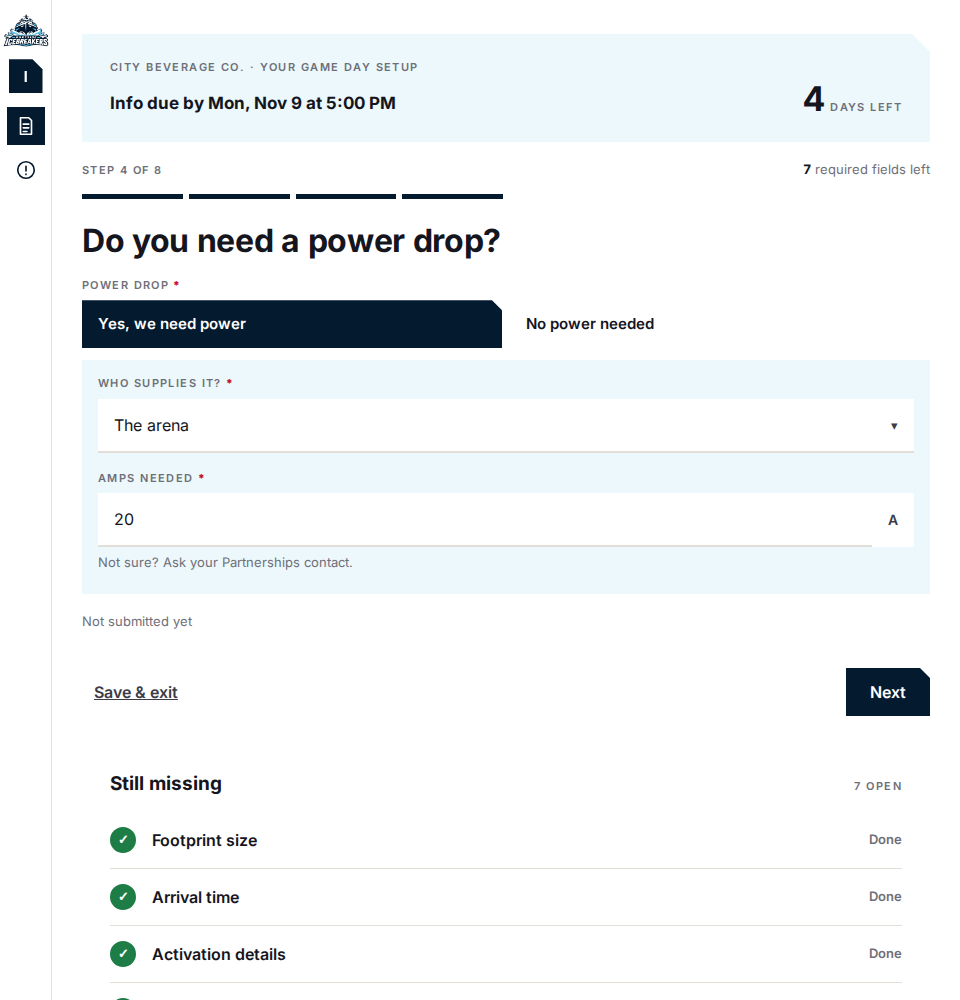
The partner intake form for City Beverage Co. in the sample game: eight short steps starting with who is on site, due Monday, Nov 9 at 5:00 PM.

1

Partners submit complete information the first time.

The form asks for tables, chairs, power, and a drawing of the setup, up front.

The chase board listing what each partner still owes, marked incomplete against the Monday 5 PM deadline.

2

The deadline is enforced and tracked.

Everything is due Monday at 5:00 PM. You can see who still owes what, and chase from the same board.

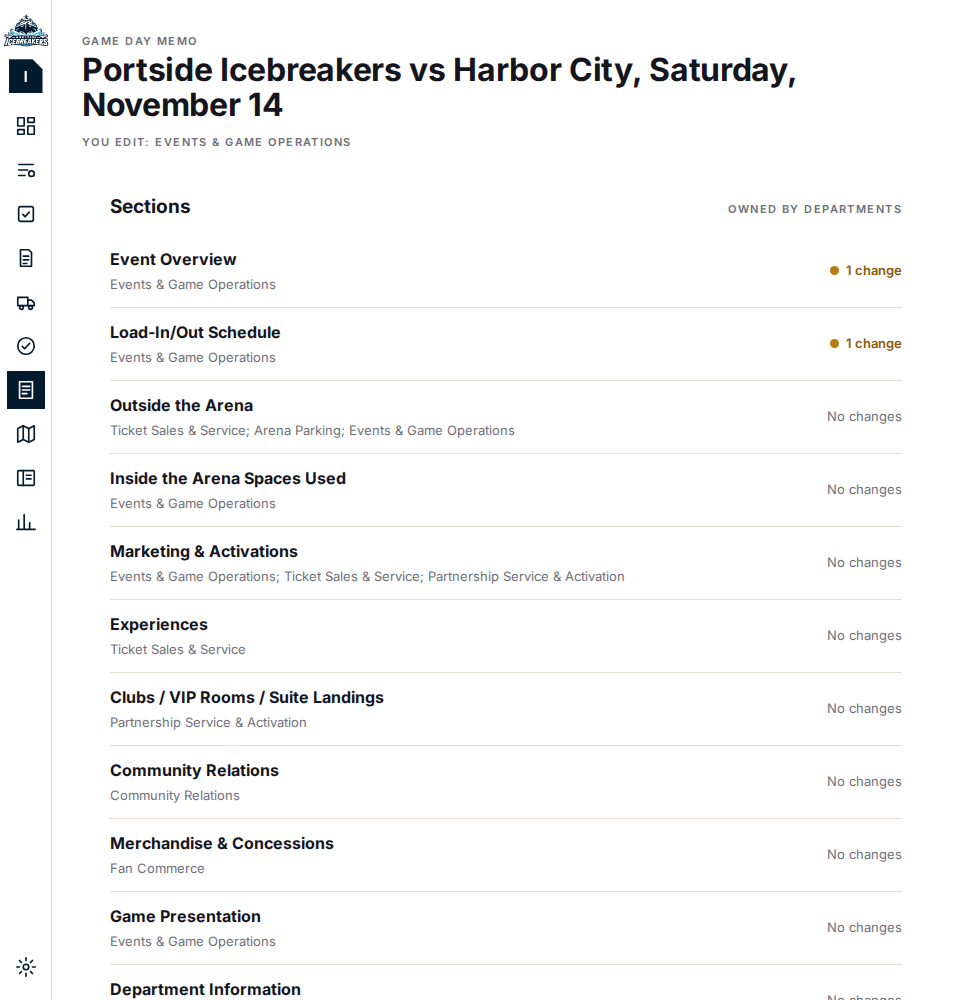
The game day memo's sections, each owned by a department: event overview, the load-in schedule, outside the arena and inside the arena.

3

Events receives only what is complete and approved.

It flows into the game day memo. Nobody copies and pastes.

Who does what, step by step

Partners

Submit activation details once: footprint, arrival time, tables, chairs, power, and parking passes.

Partnerships

Review every record, chase what is missing, and approve what is complete.

Events and game ops

Work from complete, approved information in the game day memo.

Arena ops

Run load-in on schedule and confirm every delivery at the arena.

How a home game week at the rink goes now, and how it could go

You want every partner set up in the right place, at the right time, with what they were promised. What gets in the way is information that arrives incomplete. Someone on your team chases it. The handoff to Events runs late, and game day becomes a scramble.

Your team finds out in front of the partner, the arena staff, or the fans.

With By Face Off, the chasing is built into the system instead of your week. Partners cannot submit half-finished information. The Monday deadline holds because the board shows, at any moment, exactly who still owes what. Events works from the finished memo, not from the last email.

After three home games, the pattern sets. Events stops chasing partners. Late changes drop. The details that used to surface on game day are settled on Monday.

Design partner spots this season are limited to a small number of teams.

A short call first. We look at one of your home game sheets together, and you decide from there.